Organising Your Home for a Neurodivergent Child
We are all different
We all respond differently to mess, tidying, routines and what we consider to be “organised”. That’s just human nature.
For those of us who may be neurodivergent ourselves, or who are parenting neurodivergent school-age children, it can sometimes feel difficult to know where to begin when trying to keep a busy family home organised.
I’m going to outline just a few simple ideas that can help when organising a child’s bedroom, playroom or family space. There is sadly no “one size fits all”, and different systems will work for different children. Let’s face it, neurodivergent or not, we all have different personalities, preferences and homes!
The most important thing is to create systems around how your child actually uses their space, rather than how you think they should use it.
1. Make things easy to see and easy to put away
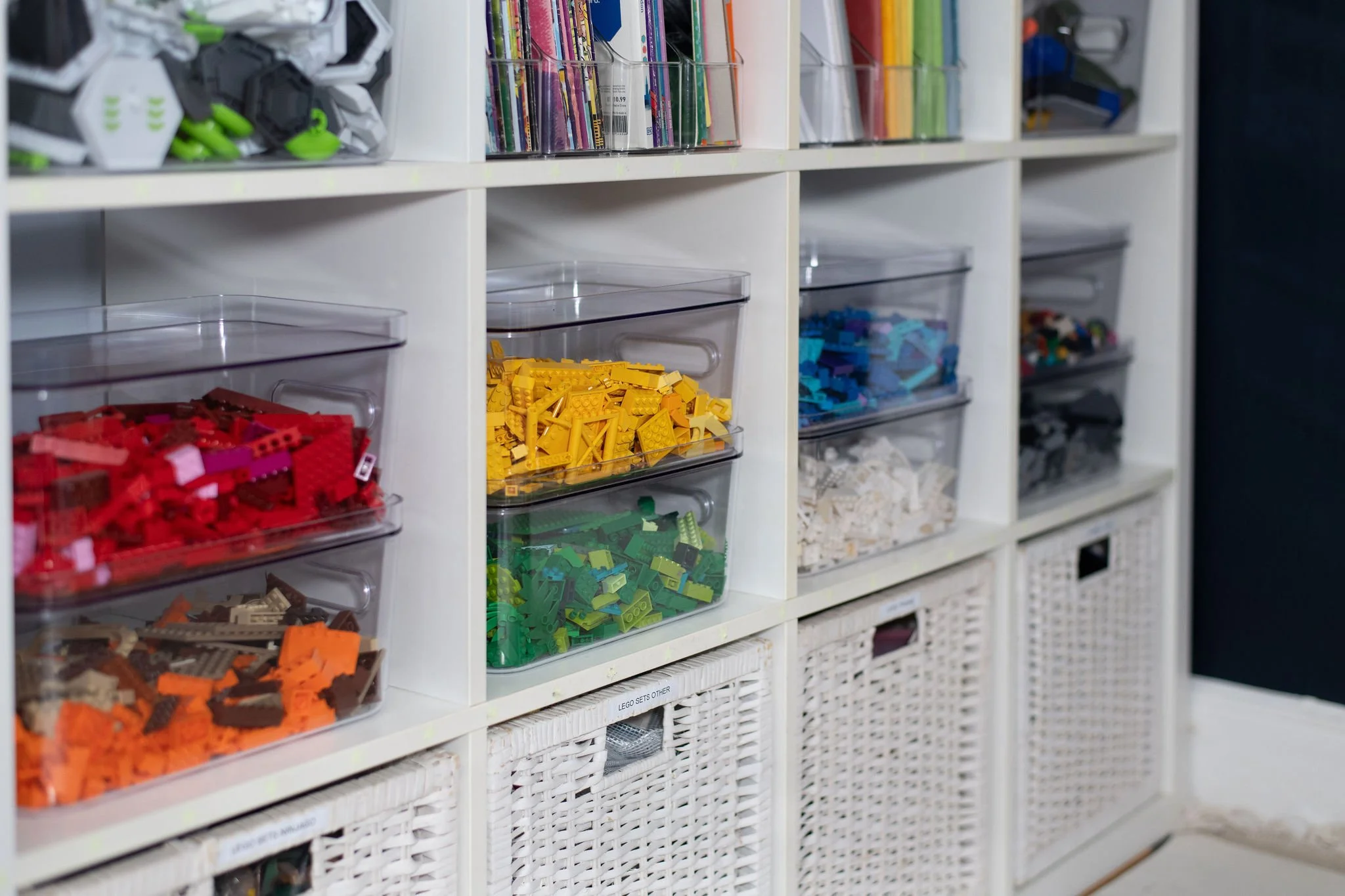
Clear organising tubs can work brilliantly for many children. For some, out of sight can quickly become out of mind, so being able to visually see their toys on a shelf allows them to know what is there and choose what they want more easily.
They can also make tidying much simpler. Putting a toy back into one clearly defined tub is much easier than putting it into a zip-lock bag, inside another box, inside a cupboard. Many neurodivergent children can find tasks easier when there are fewer steps involved.
Labels can help too, either with words, pictures or both, depending on what works best for your child.
Of course, visible storage won’t suit everyone. Some children may find seeing lots of belongings visually overwhelming and prefer closed storage with a clear label on the front. The key is finding what makes the space feel easier for your child to use.
2. Keep categories simple
It can be tempting to create beautifully detailed organising systems, with a separate box for every type of toy. But if the system is too complicated, it is unlikely to be maintained.
Instead of having separate boxes for farm animals, dinosaurs, sea creatures and figures, one larger Animals box may work much better.
Broad, obvious categories remove some of the decision-making from tidying up. The easier it is to work out where something belongs, the more realistic the system is to maintain.
3. Organise around where things naturally end up
Before deciding where everything should live, spend a little time noticing where things naturally get left.
If dirty clothes always end up beside the bed, perhaps that is exactly where the laundry basket needs to be. If school bags and shoes are always dropped by the front door, create an easy-to-use space for them there.
Sometimes the answer isn’t to change the habit. It is to create a system around it.
A good organising system should make everyday life easier, not create another set of rules that everyone struggles to follow.
4. Use visual reminders
For children who find it difficult to remember a series of tasks, simple visual prompts can be really helpful.
This could be a short checklist by the front door:
Shoes away → coat on hook → lunchbox in kitchen → school bag away
Or a picture label on a drawer showing exactly what belongs inside.
Try to keep visual reminders simple. A huge, beautifully designed chart with twenty steps can sometimes become another thing to ignore! A few clear prompts, placed exactly where the task happens, are often much more useful.
5. Involve your child in creating the system
One of the most useful things you can do is involve your child in deciding how their room or belongings are organised.
Ask them where something would make sense to live. Which toys do they use most often? Would they prefer something on an open shelf or hidden away? What do they find difficult about tidying their room?
The system may not be exactly how you would have organised it yourself, but if it makes sense to the person actually using it, it has a much better chance of working.
Giving children some ownership over their space can also make organising feel less like something being imposed on them.
6. Don’t try to organise everything at once
An entire messy bedroom can feel overwhelming for anyone.
Rather than saying, “Tidy your room”, which is actually a huge and fairly vague task, try breaking it down:
Let’s put all the clothes in the laundry basket.
Then:
Now let’s put the books back on the shelf.
One clear task at a time can feel far more manageable than trying to process the whole room at once.
And remember, the aim isn’t to create a perfectly organised home. It is to create a space that feels calmer, easier to use and more manageable for the child and family living in it.